The Permission Problem - Megawatt Monthly Newsletter - October 2026
The Megawatt Monthly · October 2026 · By Joshua Holmes
Over the past year, the biggest story in the data center industry quietly changed. It's no longer mainly about GPUs, rack densities, or who signed the latest nuclear deal. It's about permission: who gets to build, where, how big, and who pays for the wires.
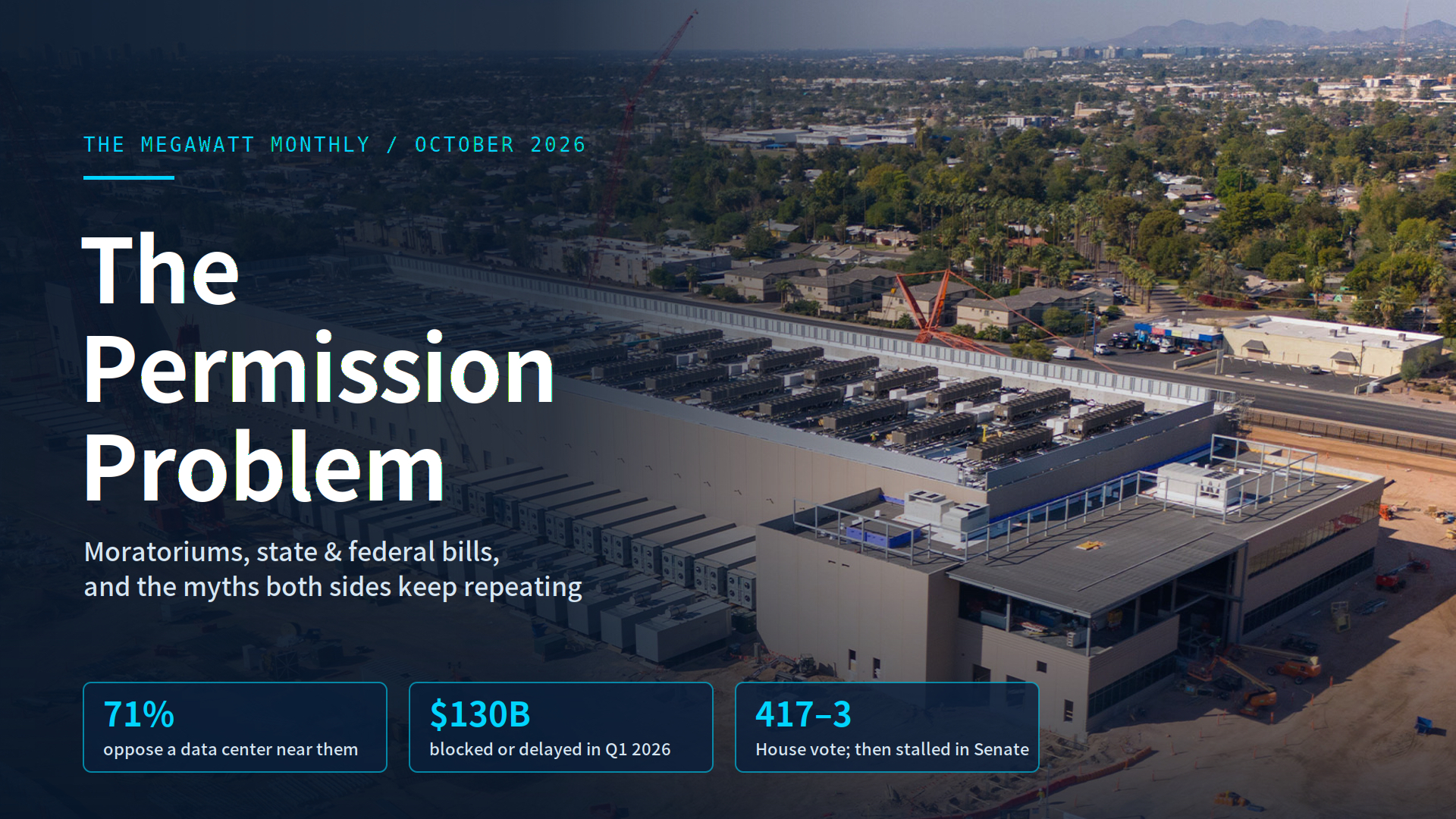
In March, Gallup polled Americans on data centers for the first time. 71% said they'd oppose an AI data center in their area, 48% strongly. For comparison, 53% said they'd oppose a nearby nuclear plant. Let that sink in for a moment: as an industry, we now poll worse than nuclear.
This post is a field guide. Where the opposition is and why, which places have moratoriums and what they actually say, which state and federal bills are worth reading, who is organizing on each side, and the myths — from both camps — that keep getting repeated. I run data centers for a living, so weigh my perspective accordingly. I've tried to be straight about where the industry is right and where it has earned the skepticism.
Key takeaways
Local opposition blocked or delayed about $130 billion in U.S. data center projects in Q1 2026, and 71% of Americans say they would oppose a data center near them.
No state legislature has enacted a statewide construction moratorium. The statewide actions so far (New York, Texas, Pennsylvania, and others) came from governors' executive orders.
State moratorium thresholds mostly fall between 20 and 50 MW, but local rules use lower thresholds, square footage, or no definition at all, so smaller facilities can still be affected.
"Pay your own way" cost allocation for large loads is the bipartisan middle ground, both in state law and in the federal Ratepayer Protection Act, which passed the House 417–3 and stalled in the Senate.
Popular claims about water use, on-site power, electric bills, and jobs are each partly true and partly wrong, depending on cooling design, market, and timeframe.
1. The opposition: where it is and why
The scale is no longer local noise.Data Center Watch, a tracker run by research firm 10a Labs, counted at least 75 projects worth roughly $130 billion blocked or delayed by local opposition in Q1 2026 alone — about the same as all of 2025 combined. Organized opposition groups more than doubled from 396 at the end of 2025 to 833 by the end of March, and they're now active in 49 states. Q2 added another 45 projects worth about $68 billion.
It's bipartisan. Gallup found majorities of both Republicans and Democrats oppose a data center near them. Resistance is strongest in the Midwest (76%) and the South (75%) — exactly where most new capacity is being sited.
The stated reasons, in order:
Resources (about half of opponents): water and electricity consumption, and grid strain.
Quality of life (22%): property values, traffic, and the sheer land footprint.
Pollution (16%): noise, light, heat, and on-site generator or turbine emissions.
AI itself (14%): a general dislike or distrust of AI, with a smaller share worried about job displacement.
The reasons people don't say in polls but say at zoning meetings: secrecy and tax breaks. Projects routed through non-disclosure agreements before residents learn what's coming are a recurring flashpoint — Pennsylvania just banned state agencies from signing them. And the tax math has started making headlines: Ohio's sales-tax exemptions for data center equipment and construction materials ran nearly $1.57 billion last year, almost 12 times what the state originally projected.
One wrinkle worth noticing:polling from Milltown Partners found only 8% of data center opponents know of one near their home, and Pew found that living near a data center doesn't change people's views much. Pew also found 87% of existing data centers are in urban areas, while two-thirds of planned ones are rural. My read: some of this opposition is really about AI and affordability, and the data center has become the most visible, most local symbol of both. The buildout moving into farm country made that symbol a lot easier to see.
2. The moratorium map
Statewide actions
No state legislature has enacted a statewide construction moratorium. Maine's legislature passed one, and the governor vetoed it in April (she did sign a separate bill barring data centers from certain state business incentives). Bills in Minnesota, New Hampshire, Oklahoma, South Dakota, Wisconsin, Maryland, and Georgia died or stalled. Instead, governors in both parties have been acting on their own. By my count, at least nine have used executive power on data centers this year:
New York — Executive Order 62 (July 14). (Governor's announcement · legal summary) The only true statewide permitting moratorium. It pauses discretionary state environmental permits for data centers that can draw 50 MW or more, for up to a year. It doesn't apply to local permits, to applications already deemed complete, or to projects that don't need discretionary state approval. The trigger: nearly 12 GW of data center load requests in the state grid operator's queue.
Texas — grid and permit pause (August 3, expanded September 21). (August directive · September permit halt) Gov. Abbott ordered ERCOT and the PUC to audit every data center in the interconnection queue before approving more. ERCOT is looking at roughly 474 GW of connection requests — more than five times the state's record peak — and about 90% of it is data centers. On September 21 the pause was extended to environmental permits at TCEQ. BloombergNEF estimates nearly 50 GW of U.S. pipeline is exposed, and Abbott's office says he'll push to eliminate data center incentives next session. Yes, Texas.
Pennsylvania — Executive Order 2026-05 (August 18). (explainer · coverage) Not a moratorium, but arguably stricter in practice. Any data center over 25 MW must sign a legally binding consent order to meet the governor's GRID requirements. Data centers are out of the state's fast-track permitting program, state agencies can't sign NDAs, local approval is required, and operating facilities must report annual energy and water use starting July 2027.
Kentucky — Executive Order 2026-494 (August 6). (coverage · Kentucky Resources Council response) Developers must file an energy plan showing they won't raise anyone else's electric bills, the PSC is directed to block utilities from recovering data center costs from other customers, and the state environmental cabinet is told to deny permits for projects that would harm air, water supply, wetlands, or natural resources. Gov. Beshear was explicit that the yes-or-no decision stays local. It came after a statewide restrictions bill (HB 593) passed the House and died in the Senate.
Nebraska — executive order (July 20). (governor's column · coverage) Gov. Pillen suspended new large-scale data center incentives under the Imagine Nebraska Act and created a task force on land, water, and power. It followed LB 1261, signed in June, which bars data centers from relying on power built and paid for by Nebraska ratepayers. At least 12 Nebraska counties had passed their own moratoriums by mid-July.
Utah — Executive Order 2026-03 (May 29). (full text · legal analysis) "Establishing a Higher Bar for Data Center Development." Directs agencies to protect ratepayers, air quality, and the Great Salt Lake, and pairs with Utah's self-supply power model and new water-reporting law.
Illinois — incentive pause (effective July 1). (coverage) After the comprehensive POWER Act stalled, Gov. Pritzker paused new agreements under the state's Data Center Investment Program and asked lawmakers to act in the fall veto session. Labor groups have publicly pushed back.
Ohio — incentive pause. (summary) Gov. DeWine directed the Tax Credit Authority to stop considering new data center tax exemption requests while a joint legislative committee works on policy.
Louisiana — Executive Order 26-058. (tracker entry) Requires new projects to fund their own power, even as the state keeps its long-term sales tax rebate.
Arizona did it by statute instead (details): the state budget Gov. Hobbs signed imposes a three-year moratorium on new data center sales tax exemption certificates, from July 1, 2026 through June 30, 2029.
Local moratoriums and bans, state by state
This is where the real volume is. One tracker counted 533 local moratorium instruments by mid-summer, with 283 adopted between May and July alone, and September may have been the busiest month yet. Here's a state-by-state sample. It is not exhaustive — new ones pass almost weekly — so check your local agenda before relying on any of it. Two trackers worth bookmarking: Programs.com's state-by-state tracker and Savrn's moratorium map.
Alabama: Cullman (one year), Fort Payne (six months). (tracker)
Arizona:Pima County (120 days, adopted September 22, while zoning code is written).
California:Monterey Park (permanent ban; Measure NDC passed with about 88% of the vote in June), Mendocino County (45-day urgency ban, extendable up to two years), Imperial County (extended moratorium set aside by a court in August).
Florida: (Florida tracker) Manatee County (12 months, September 15), Levy County (covers data centers and other large power-intensive facilities), Alachua County (12 months advanced by planning commission), Leon County (18 months, final vote set for October 13), plus earlier pauses in Sarasota, Clay County, and Lakeland.
Georgia:One tracker counts 47 local actions — the most of any state. Palmetto and Fayetteville have bans; DeKalb County extended its pause and is being sued over it; Cobb and Madison counties extended theirs; Camden County became the first coastal county to act.
Illinois:Lake County (eight months, through May 2027), Mattoon (one year on large-scale facilities, auto-renewing).
Indiana:Boone County and Madison County (one year; six months — the ninth Indiana county to pause), Owen County (one year, adopted September 22, and notably it also blocks rezoning land for future data center use during the pause).
Kentucky: (tracker) Louisville Metro (six months, 24–1 vote), Versailles (through year-end), Meade County, Boyd County (six months, with one existing project exempted), Cave City (one year, now facing an industry lawsuit), and a central Kentucky county that adopted the state's first permanent county ban to protect farmland.
Louisiana:New Orleans (one year, extendable to two).
Maryland:Baltimore (one year, 10 MW+), Prince George's County (renewed for two years), Montgomery County, Charles County (six months).
Michigan:By one count, about 1,500 square miles of the state are now off-limits under local moratoriums. Fourteen Washtenaw County communities acted after the OpenAI/Oracle campus was approved in Saline Township. Others include Howell Township, Northville (12 months), Springfield Township (180 days), Lansing (182 days), and Meridian Township.
Minnesota:Minneapolis (six months on facilities over 350,000 sq ft), Inver Grove Heights (one year), North Mankato (12 months), Rosemount, Waite Park, Lonsdale.
Mississippi:Jackson (183 days — the state's first).
Missouri:St. Charles (permanent ban, replacing a one-year pause), Springfield (120 days), Jackson County; Peculiar removed data centers from its zoning code entirely. In Festus, council members who backed a project were voted out.
Nebraska:At least 12 counties, including Logan County and Gage County (12 months).
New Hampshire:Nottingham (12 months, approved by town vote 1,335–143 — the state's first).
New Mexico:Santa Fe County (18 months on large-scale data centers).
New York:Lysander (six months), Brookhaven (18 months), Orangetown; eight municipalities have banned data centers outright.
Ohio:One tracker counts 55 local actions. Cleveland (three months), Cincinnati (extended through 2026), Lima (18 months), Pioneer (six months), Ravenna (one year), Hubbard (12 months), Boardman. Eighteen communities have data center measures on the November ballot.
Oregon:Hillsboro (120 days, covering data centers and battery storage).
Virginia:Chesapeake (eight-month application pause); Hanover County rejected a major technology park 4–3.
Washington:Seattle (emergency moratorium paired with a policy framework).
Wisconsin:Madison (facilities over 10,000 sq ft, up to one year), Mishicot; Port Washington voters now require a public vote before any data center tax incentive.
By one tracker's count, only four states — Alaska, Hawaii, West Virginia, and Wyoming — have no data center moratorium at any level of government.
On the ballot: Ohio's proposed constitutional amendment to ban data centers over 25 MW missed the 2026 ballot, but organizers say their signatures don't expire and they're aiming for 2027.
And the counter-pressure: Hill County, TX rescinded its moratorium after a developer filed a $100 million lawsuit. Imperial County, CA had its extended moratorium set aside by a court that found the county's findings didn't satisfy state law. Moratoriums are easy to pass and surprisingly easy to lose.
3. What the moratoriums have in common
Read enough of these and patterns jump out. If you're a developer, an operator, or a business trying to figure out what this means for your own infrastructure plans, these are the takeaways I'd hold onto:
The megawatt line sits between 20 and 50 MW at the state level. New York's executive order is 50 MW; the New York bill is 20 MW; Pennsylvania's order and Ohio's ballot proposal are 25 MW; Environment America's national campaign asks for a pause on 50 MW and up. Texas's batch interconnection study covers loads of 75 MW and up. Local thresholds run lower — 10 MW in Baltimore and Broomfield, and one Ohio community is voting on 7.5 MW.
Most enterprise, edge, and regional colocation facilities fall below those lines — but definitions matter more than numbers. Madison measures by square footage, not megawatts. Mendocino had no definition at all and so paused everything. And New York's pending bill defines a "data center" as anything with 1 MW or more of peak demand, with some new obligations starting at 5 MW — the moratorium targets 20 MW, but the rules reach much smaller sites. A 10,000 sq ft trigger can catch a modest regional facility that will never come close to 25 MW. If you operate or plan smaller facilities, read the definitions section first.
They're temporary by design. Most run 45 days to 18 months, and their stated purpose is to buy time to write permanent zoning. Madison's staff presented a draft zoning framework to its Plan Commission on September 29. The pause is usually the prelude to rules, not the end state.
Governors are moving faster than legislatures. At least nine governors — New York, Texas, Pennsylvania, Kentucky, Nebraska, Utah, Illinois, Ohio, and Louisiana — have acted by executive order while bills stalled, and they come from both parties. Expect more of this in election years.
"Pay your own way" is the consensus middle ground. Almost every serious proposal — left, right, and industry — lands on making large loads fund their own interconnection, transmission, and generation, through a separate rate class or tariff. The disagreement is about enforcement, not the principle.
Transparency is becoming table stakes. NDA bans, public project maps, and mandatory water and energy reporting are showing up in Pennsylvania, Utah, and a growing number of local ordinances.
Tax incentives are on the chopping block. NCSL counts 38 states with dedicated data center incentives, and lawmakers in at least 28 states introduced bills this year to curb or amend them. Washington ended some exemptions, Oregon paused one, and Illinois, Arizona, and Ohio paused new applications.
4. State bills worth researching
Hundreds of data center bills were filed across more than 30 states this year. Most legislatures have adjourned, so their unpassed bills are dead until 2027. The states still in session — Massachusetts, Michigan, New Jersey, New York, North Carolina, Ohio, and Pennsylvania — account for most of what's still alive, and one tracker counts 133 live bills among them. Here's what I'd read, state by state. Bill numbers are included so you can look them up yourself.
Status key:Enacted = law. Pending = still alive. Died/stalled = not passed this session, but often a preview of 2027.
Alabama — Enacted:SB 270 (April 17). Sets criteria the PSC must use to review utility contracts with data centers of 150 MW or more.
Arizona — Enacted:HB 4168, the state budget, imposes a three-year pause on new data center sales tax exemption certificates (July 2026 – June 2029). Gov. Hobbs had originally asked for full repeal.
California — Enacted:SB 886 and AB 2383 (September 21, effective January 1, 2027), the California Technology Innovation and Ratepayer Protection Act, as part of a seven-bill package covering environmental review, interconnection tariffs, collateral and exit fees, and cost allocation.
Florida — Enacted:SB 484 (effective July 1). Affirms local land-use authority over large-load data centers, sets minimum tariff and service requirements, limits certain water-use permits, and orders a state study.
Georgia — Died/stalled: (bill roundup) SB 408 and HB 559 (sunset the sales tax break), SB 410 (end it for new projects), HB 528 (water, power, and community-impact reporting), and HB 1012 (moratorium until March 2027). Worth knowing: a state audit estimated the exemption has cost at least $1.5 billion and that about 70% of the investment would likely have come anyway. Georgia's PSC already has a large-load cost rule for Georgia Power, which supporters cite as a model.
Illinois — Pending:The POWER Act, billed by sponsors as the most comprehensive data center bill in the country (data centers pay for their own generation, sourced from new renewables and storage). It stalled in May, and Pritzker wants it addressed in the fall veto session. Also SB 2181, a data center energy and water reporting act.
Kentucky — Died/stalled:HB 593 (statewide restrictions) passed the House and failed in the Senate, which led to the governor's executive order.
Maine — Vetoed: the statewide moratorium (LD 307). Enacted: a separate bill barring data centers from certain state business incentives.
Maryland — Enacted:HB 1532, the Utility RELIEF Act (May 12). Died/stalled: HB 120 (moratorium). Notably, Gov. Moore has also declared data centers critical infrastructure and signed permit-streamlining legislation — Maryland is regulating and courting at the same time.
Michigan — Pending: A multi-bill package built around a data center planning and responsibility act, which would also amend the zoning enabling act (introduced June 25, in committee), plus six bills to trim tax breaks. Michigan's attorney general is also challenging the state PSC's approval of the utility contract for the Saline Township campus.
Minnesota — Died/stalled:HF 4888 / SF 4298 (moratorium until a year after a PUC report) and a bill banning NDAs between data centers and local governments. Already on the books: HF 16 (2025) large-customer rate class.
Nebraska — Enacted:LB 1010, the Large Load Customer Regulation Act (April 17), and LB 1261 (June), which keeps data centers from relying on generation built and funded by ratepayers.
New Hampshire — Died/stalled:HB 1265 (one-year moratorium) was killed in the House.
New Jersey — Enacted:S731/A796, Data Center Fair Share (July). Creates a data center rate class so large facilities pay for their own energy and grid infrastructure, and lets them be curtailed before residential load during grid stress. Pending: a cluster of bills on local-disclosure requirements, water impacts, state planning approval, and prevailing wage for construction.
New York — Pending:S10642/A11560, the Responsible Data Center Development Act (sponsor's summary). Passed both chambers in June (44–16 in the Senate, 102–39 in the Assembly). One-year pause at 20 MW, new electric and water rate classes, efficiency goals, host community benefits, project labor agreements, and public hearings before permits. Awaiting the governor; several law firms expect a veto in light of her executive order, while advocates are pressing her to sign.
North Carolina — Enacted:SB 257 repealed the sales tax exemption on electricity used by data centers (equipment exemptions remain). Pending:HB 1213 would repeal the remaining data center sales tax exemptions.
Ohio — Pending:Substitute HB 646 (what's in it). It passed the House 97–0 as a simple study commission, then the Senate rewrote it into a roughly 50-page framework: facilities drawing more than 250 MW would have to generate or procure their own power, serving costs would be walled off from other ratepayers, sales tax breaks would shrink, and facilities would need closed-loop cooling or water-efficiency best practices. It stalled in June but remains alive, along with several other tax-break bills. HB 975 would end the sales tax exemption outright.
Oklahoma — Enacted:HB 2992, the Data Center Customer Ratepayer Protection Act (May 11), requiring separate terms and tariffs for large loads. Died/stalled:SB 1488 (construction prohibition until 2029).
Oregon — Enacted: a one-year pause on one of its data center tax incentive programs (March), building on the 2025 POWER Act (HB 3546), which created a separate rate class for large loads.
Pennsylvania — Pending (in session through November 30): (fall preview · advocates' view) SB 1345 (optional 18-month local moratorium on hyperscale applications; up for third consideration in the Senate), SB 1359 (three-year statewide moratorium), HB 2496 (a pause bill that passed the House), SB 1114 (Pennsylvania Ratepayer Protection Act; separate large-load class paying full incremental grid costs), HB 2775 (developers must secure an electricity provider before zoning approval), HB 2674 (bars data centers from public utility status and eminent domain), and several tax-break cuts that have already cleared the House, including HB 1667, HB 2198, HB 2359, and HB 2650 (tax-break tracker).
South Dakota — Died/stalled:SB 232 (hyperscale moratorium until mid-2027). HB 1005, a 50-year sales tax exemption, was rejected 9–3 in committee.
Tennessee — Enacted:HB 1847, the Data Center Cost Responsibility Act (May).
Texas — Enacted (2025):SB 6, which requires large loads to pay their own interconnection costs, disclose duplicate service requests, and meet financial-commitment standards. Next: incentive repeal is on the governor's 2027 agenda.
Utah — Enacted:HB 76, Data Center Water Transparency Amendments (March), plus the 2025 SB 132 self-supply law.
Vermont — Pending/introduced:H.727, a separate ratepayer class and tariff schedule for data centers.
Virginia — Enacted: Of 61 data center bills this session, 15 reached the governor. The budget (HB 30, effective July 1) kept the sales tax exemption but added a new tax of 1.1 cents per kWh consumed by data centers, alongside a package shifting grid costs to operators and a new siting process for facilities of 100 MW+ that requires noise assessments for homes and schools within 500 feet. Pending for 2027: 46 bills carried over, including HB 1515, and a work group reports in November.
Washington — Enacted:ESSB 6231 (April 1), which ended the sales tax exemption for replacement server equipment and refurbished urban data centers starting July 1.
West Virginia — Enacted (2025):HB 2014 microgrid districts; HB 4983 sets the certification rule for microgrid districts and high-impact data centers.
Wisconsin — Died/stalled:SB 1061/AB 1099, which would have barred data center operation until certain conditions were met.
5. Federal bills: Congress finally showed up
Until this fall, federal action was mostly a voluntary pledge. That changed in September, when data center costs got their first real floor votes. Here's the federal landscape:
Ratepayer Protection Act, H.R. 9340 (House: Rep. Gabe Evans, R-CO, with Rep. Kathy Castor, D-FL; Senate: Sen. Jon Husted, R-OH). Bill text · House roll call · White House statement · Sen. Husted. Amends the Public Utility Regulatory Policies Act to create a federal standard that state regulators must consider: customers with 100 MW or more of peak demand at a single site pay the full incremental cost of generation, transmission, and distribution upgrades, with financial assurances up front. It passed the House 417–3 on September 16. In the Senate, a unanimous-consent request was blocked, and a motion to advance it failed 57–43 (coverage) at the end of September, short of the 60 votes needed. Supporters frame it as codifying the Ratepayer Protection Pledge; critics, including the League of Conservation Voters, call it toothless because it only requires states to consider a standard.
GRID Savings Act of 2026 (Sen. Martin Heinrich, D-NM; announcement). Introduced August 3. Notably, it exempts ERCOT. The Democratic alternative. It would give FERC rulemaking authority over facilities of 150 MW or more and require them to pay for the grid costs they create. Heinrich blocked the Ratepayer Protection Act in favor of this approach.
Artificial Intelligence Data Center Moratorium Act (Sen. Bernie Sanders, I-VT, and Rep. Alexandria Ocasio-Cortez, D-NY; introduced March 25; announcement). Would halt new AI data center construction until protections for workers, consumers, and the environment are in place. Very low odds, but it's the national marker the state moratorium fights reference.
Data Center Water and Energy Transparency Act, S. 4213 (Sen. Dick Durbin, D-IL; introduced March 25; bill text · announcement). Requires operators to report energy and water use to their states, requires prospective projects to estimate five years of consumption, shares that data with local governments, and allows EPA, DOE, and USDA to fine non-compliant facilities. Referred to the Senate Energy and Natural Resources Committee.
Sen. Mark Warner's data center transparency bill (D-VA; introduced July 21; summary). Would require large data centers to publicly report energy and water use, emissions, and backup generation, and would reward efficient facilities through LEED certification. From the senator representing the largest data center market in the world, that's notable.
S. Con. Res. 30 (introduced March 25; text). A non-binding resolution endorsing the White House Ratepayer Protection Pledge as sound national policy.
What to watch: whether the Ratepayer Protection Act comes back after the midterms. Majority Leader Thune has signaled the Senate could take it up. The realistic federal outcome, if there is one, is a cost-allocation standard. A federal moratorium isn't happening.
6. Who's organizing — on both sides
Supporting the buildout
Data Center Coalition (DCC) (website). The industry's main trade group, backed by Amazon, Microsoft, Google, and others. It has registered state-branded nonprofits — North Carolina Connects, Oregon Connects, and others across seven states — that run ads on jobs, taxes, and "paying our own costs." North Carolina Connects alone bought 747 ad spots for about $367,000. Coverage of who was behind the ads has drawn its own backlash; in Hillsboro, OR, the city council passed a 120-day moratorium while the Oregon campaign was running.
Build American AI (Axios · NBC News). An advocacy group tied to the Leading the Future super PAC (backed by Marc Andreessen, Ben Horowitz, and OpenAI's Greg Brockman). Launched a multimillion-dollar ad campaign August 31, starting in Kansas, Ohio, and Wisconsin. It holds up Colorado, Georgia, and Texas as model states — though Denver and Broomfield have both paused and Texas froze approvals weeks earlier.
The White House Ratepayer Protection Pledge (fact sheet · July expansion). Signed March 4 by Amazon, Google, Meta, Microsoft, OpenAI, Oracle, and xAI, and expanded in July to include 23 governors and roughly 187 organizations, including 55 utilities and 27 developers. Voluntary — critics call it toothless, and that gap is exactly what the state tariff laws are filling.
Also in this camp: state chambers of commerce and, often, building trades unions, who see thousands of construction jobs.
Opposing or pushing for limits
Grassroots groups — 833+ of them by Data Center Watch's count, mostly organized on Facebook around a single proposed project.
A note on Data Center Watch: it's a research tracker, not an advocacy group. It's the most-cited source on project disruptions, and it's worth reading in full.
7. Where they're still rolling out the welcome mat
Not everyone is pulling back. But notice the strings attached to the welcome:
West Virginiacreated "microgrid districts" free from local zoning and utility rate regulation, where data centers can buy power from standalone plants. By one tracker's count, it's one of only four states — with Alaska, Hawaii, and Wyoming — with no moratorium at any level.
Louisianaoffers a sales tax rebate of up to 20 years, paired with an executive order requiring new projects to fund their own power.
Mississippi, Utah, and Oklahoma have all made it easier for large loads to procure their own generation outside the normal utility path.
The new deal in the friendly states isn't "come on in." It's "come on in — and bring your own power."
8. Myths worth retiring (from both camps)
Myth: "Every data center drinks a small town's worth of water" — or "modern data centers don't use water"
Both are wrong because cooling design varies enormously. Lawrence Berkeley National Lab estimates U.S. data centers directly consumed about 17.4 billion gallons for cooling in 2023 — and roughly 211 billion gallons indirectly through the power plants generating their electricity, about 12 times more. Facility-level numbers range from trivial to enormous: Google's own disclosures show one Texas site using around 10,000 gallons in a year and an Iowa site near a billion.
The big swing factor is evaporative versus closed-loop. Traditional evaporative cooling towers consume water continuously. Newer direct-to-chip, closed-loop designs fill once and recirculate; Oracle, for example, says ongoing cooling water use at its new AI sites is effectively zero beyond normal office use. The honest version: water is a real issue for evaporative designs in water-stressed areas, an increasingly solvable one for new builds, and the bigger footprint usually sits at the power plant, not the building.
Myth: "Data centers build their own power, so they don't touch the grid"
Behind-the-meter generation is real and growing fast, but it's mostly still on paper. Cleanview identified about 90 GW of announced self-generation across 59 projects, yet only about 2 GW was actually online by mid-2026. More than 80% of announced on-site generation is natural gas. Enverus expects behind-the-meter to serve roughly 40% of new capacity by 2030 — which means the majority will still be grid-connected. And on-site gas brings its own fights over air permits; a 400 MW plant in New Jersey has been held up on exactly that.
Myth: "Data centers are why your electric bill went up" — or "they never raise bills"
The past and the present tell different stories. A June 2026 EPRI study found data center growth actually lowered average U.S. retail rates modestly from 2015 to 2024 — more kilowatt-hours spread fixed grid costs further. Rutgers researchers likewise found no robust bill impact in that pre-hyperscale window.
But capacity markets are where it's showing up now. In PJM, the capacity auction went from $28.92/MW-day to $269.92, then $329.17. PJM's independent market monitor attributed 63% of that first jump — about $9.3 billion — to data center demand. So: historically, no; in constrained markets going forward, yes, unless cost allocation changes. That's precisely why rate-class and tariff laws are the most popular policy response.
Myth: "Data centers create thousands of jobs" — or "they create no jobs"
They create a lot of construction jobs and relatively few permanent ones. Georgia counted roughly 28,350 data center construction jobs in 2025 against about 5,471 permanent operations jobs — around five to one. Large campuses can still employ hundreds once running, and the trades work is real and well paid.
Where it breaks down is the subsidy math. Good Jobs First finds taxpayer costs routinely exceed $1 million per permanent job. In one extreme New York case, a bank's data center expansion was approved for nearly $77 million in tax breaks in exchange for one permanent job. Communities have noticed.
Myth: "A data center is a data center"
This is the one I'd most like to see retired. A 1–5 MW regional colocation facility serving local businesses, a 30 MW enterprise site, and a 1 GW AI campus with its own gas turbines are completely different neighbors. Gallup asked specifically about "AI data centers," and most of the thresholds above are aimed at the big end. Smaller facilities also tend to employ more people per megawatt than hyperscale sites. Lumping everything together makes for worse policy and worse debate.
The operator's take
I'll say the uncomfortable part first: my industry earned a good share of this. Projects hidden behind NDAs until the vote. Speculative "phantom load" filling interconnection queues — Texas's audit exists largely because no one could tell real demand from placeholders. Subsidy deals that look indefensible when you divide by the job count. When the pitch outruns the facts, people stop trusting the facts.
But some of the backlash is aimed at a version of the industry that's already changing. Closed-loop cooling is becoming standard for high-density builds. "Pay your own way" tariffs are becoming law in red and blue states alike. The fights ahead are increasingly about terms, not existence.
If a project is proposed in your community, here are the questions I'd ask, in order:
How many megawatts at full build-out — not phase one?
Evaporative or closed-loop cooling, and what's the annual water consumption?
Who pays for interconnection, transmission, and new generation — and is that in a tariff or just a promise?
Is there on-site generation, and what are the air permit terms?
How many permanent jobs, and what's the incentive cost per job?
Are any public officials under an NDA?
And if you're a business deciding where your own workloads live, keep an eye on this. Large-scale capacity is getting slower and costlier to bring online, and well-run regional facilities that already have power, already have permits, and are already part of the community aren't the target of most of these rules. That's not a sales pitch — it's just where the lines are being drawn.
What are you seeing where you are? I'd genuinely like to hear about proposals, pauses, or bills in your area that belong in the next issue.
This article was originally published in The Megawatt Monthly, an operator's view on the data center industry, written by Joshua Holmes at LightSpeed Hosting. Policy details are current as of October 2026 and change quickly, so check the linked sources for the latest status.
LightSpeed Hosting provides colocation, private cloud (XCP-ng), business fiber, and managed IT for operators who'd rather own their infrastructure than rent someone else's promises. lightspeedhosting.com | (888) 929-9639